Grizzled Captain
The SympathizerThe Grizzled Captain is a former guerrilla hunter and South Vietnamese officer reduced in exile to working as a short-order cook. His passage from commanding men in war to volunteering for a mission he expects may be suicidal makes him a figure of the veterans’ lost status and unresolved grief. He is neither simply a relic of military life nor merely a displaced man: the purpose he finds in the General’s new army is bound to the family he lost and the country he hopes to return to.
Identity and Background
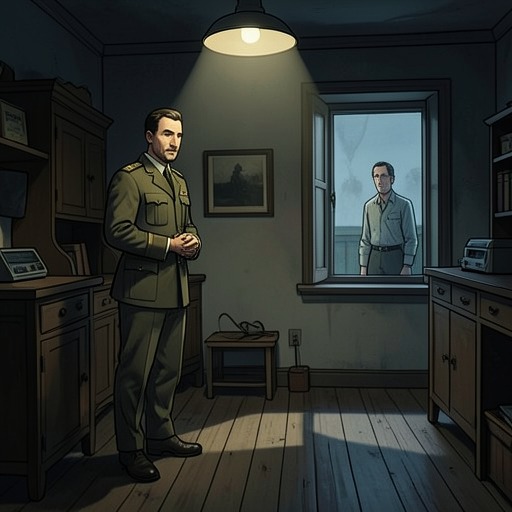
Before exile, the Grizzled Captain hunted guerrillas; in America, he earns his living as a short-order cook. The unnamed narrator places him among former officers and enlisted men whose wartime rank has not protected them from menial work and social diminishment. The contrast is especially stark in his case: a man once charged with hunting fighters now works in a civilian job, while the military identity through which he understood himself has become difficult to sustain.
His family was separated from him in the upheaval at Da Nang. He tells the unnamed narrator that his wife and children did not make it out, and that the last he heard, communist forces had sent them to clear swampland because they were related to him. He sees two possibilities: wait for them to be released, or go and get them himself. That uncertainty gives his decision to return to danger a personal stake beyond the General’s political project.
The General’s Army and a Renewed Purpose
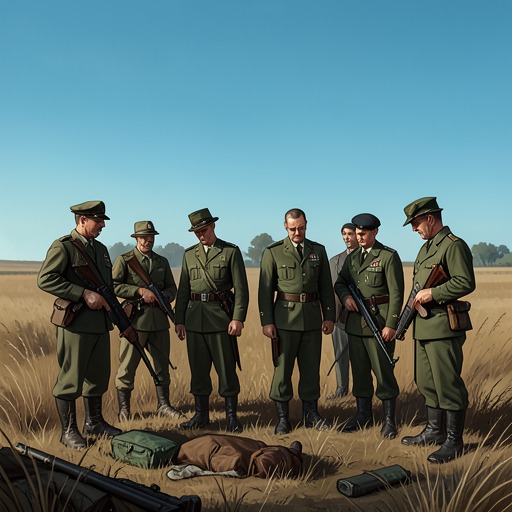
The General assembles an exile force from experienced volunteers, building its officers and noncommissioned officers through trusted networks before moving on to training and maneuvers. The Grizzled Captain becomes one of the men who help turn the group into a fighting unit. During a training weekend, he yells instructions as recruits do push-ups; elsewhere, he and the Affectless Lieutenant command men in the field. The force has uniforms, drills, and a plan for organization, although its proposed heavy-weapons platoon has no heavy weapons yet.
The uniform changes what exile has made visible about these men. In civilian clothes they had blended into the background as laborers and service workers; in field caps and berets, standing straighter and marching rather than shuffling, they become recognizable as soldiers again. The General contributes to that change by walking among them, eating with them, and remembering their names and family histories. The Grizzled Captain’s participation places him within a community where military identity is being rebuilt through discipline and recognition, not just through weapons.
He volunteers for reconnaissance in Thailand alongside Bon and the Affectless Lieutenant. The unnamed narrator regards the volunteers as men prepared to fight against daunting odds, but also worries that some may not intend to return. The Grizzled Captain’s own account makes that fear credible: he has already ordered men to what he understood as certain death, and now accepts that his turn may have come. He says he is looking forward to it, while insisting that he does not want pity. The mission offers him action where exile has left him with waiting, but his willingness to risk his life also reflects how little he expects from the life he has been given.
Family Loss and the Meaning of Manhood
When the unnamed narrator asks what became of the volunteers’ families, the Grizzled Captain answers with his own loss. He speaks through clenched teeth, as if gnawing at his words, and describes the possibility of going back for his wife and children. His account does not establish whether they are alive or whether he could reach them; it establishes that he has not accepted separation as a settled past. The mission therefore carries the hope of rescue alongside the likelihood of danger.
His understanding of manhood is shaped by both military command and family responsibility. Bon later condemns the exiled veterans who take out their humiliation on their wives and children, distinguishing that conduct from a man’s duty to protect those close to him. The Grizzled Captain’s own stated wish to recover his family gives that distinction particular force, although the narrative does not present a later reunion or confirm what became of them. His history of sending men toward death also complicates any simple image of him as an uncomplicated protector: the same soldierly experience that equips him to lead has taught him how readily a military purpose can demand lives.
Departure and Narrative Significance
Two days after the unnamed narrator kills Sonny, the Grizzled Captain leaves America with Bon, the unnamed narrator, and the Affectless Lieutenant. The General and Madame see the group off at the airport. As the plane rises, the captain looks out the window and makes clear that he has had enough of America. The Affectless Lieutenant shares his rejection of the country they once called beautiful. Their departure is not a return already achieved but a threshold crossing: the men abandon the exile that has stripped them of status for a journey whose risks they understand and whose outcome remains uncertain.
On the journey, Claude takes the group to an alley of bars and clubs. The Grizzled Captain enters the establishment Claude has selected, grinning broadly; the Affectless Lieutenant also approves, though without smiling. The moment supplies a brief, coarse contrast to the captain’s grave account of bereavement and anticipated death. He can still respond with ordinary pleasure and companionship, even as the mission ahead is framed by loss. Taken together, his work as a cook, his memory of command, his missing family, and his readiness to go back make him a portrait of exile’s damaged alternatives: accept a diminished civilian life, or seek meaning in a return that may cost him everything.